Do iPhone Chargers Work in Australia? The Complete Guide for American Travelers
Yes, iPhone chargers work in Australia — but you need one specific accessory that most Americans forget to pack, and without it you cannot charge anything at all when you land.
Yes, iPhone chargers work in Australia. Every genuine Apple iPhone charger is rated 100–240V, which means it handles Australia’s 230V electricity automatically with no voltage converter needed. However, Australia uses a unique Type I plug with two or three angled flat prongs — completely different from the flat parallel US-style prongs on your charger. You must buy a Type A to Type I plug adapter before you travel. Without it, your charger physically cannot connect to any Australian wall outlet. The adapter is small, inexpensive, and available at most electronics and travel stores before you leave home.

MOMAX 100W Universal Travel Adapter
A premium 5-in-1 GaN travel adapter for readers who want to charge an iPhone, iPad, and compatible USB-C laptop from one compact unit in Australia and other destinations.
- Australia-compatible Type I plug
- Up to 100W USB-C output for high-power devices
- Useful for multi-country and multi-device trips
As an Amazon Associate, we may earn from qualifying purchases.
I have charged iPhones across Australia — in Sydney hotels, Melbourne Airbnbs, and beachside accommodations in Queensland — using the exact same US Apple charger I use at home. A simple Type A to Type I plug adapter was the only thing I needed each time. No voltage converter, no settings to change, no special charger to buy. Australia’s 230V electricity is handled silently and automatically by the universal voltage technology built into every Apple charger. Pack your adapter, and your iPhone charger works perfectly anywhere in Australia.
Australia-ReadyAustralia is one of the most popular long-haul destinations for American travelers — and one of the most common pre-trip questions I get from readers is whether their iPhone charger will actually work down there. It is a fair question. Australia uses higher voltage than the US, and those distinctive angled plug sockets look unlike anything we use at home.
The good news is that the answer is simple and reassuring. Your Apple charger handles the electrical difference automatically. The only thing you need to figure out before you fly is the physical plug shape. Let me walk you through everything clearly.
Why iPhone Chargers Work in Australia Without a Converter
Australia runs on 230V electricity at 50Hz. The United States runs on 110–120V at 60Hz. That is roughly double the voltage. For many appliances this difference would be instantly destructive. For Apple iPhone chargers, it is completely handled automatically.
Every genuine Apple power adapter contains a switching power supply. This internal technology detects whatever voltage the wall outlet is delivering and converts it correctly. The specification label on every Apple charger reads “Input: 100–240V ~ 50–60Hz.” That range covers every country on Earth — including Australia’s 230V / 50Hz system.
Apple designs every iPhone charger for global use from the start. Because Apple sells iPhones in virtually every country — including Australia, where iPhone market share is exceptionally high — every charger must work in every electrical environment. The same 20W USB-C adapter sold at an Apple Store in New York and an Apple Store in Sydney contains identical internal electronics. Only the plug shape on the included adapter or box may differ by region. The voltage handling capability is always universal.
The Australian Type I Plug — The One Thing You Cannot Forget
Here is the practical problem you need to solve before your trip: the physical plug shape.
Australia uses the Type I socket standard. The plug has two or three flat angled prongs arranged in a V-shape — the two main prongs splay outward at an angle, with an optional grounding prong above or below them. This design is used in Australia, New Zealand, Papua New Guinea, and a handful of Pacific island nations. It is unlike any other plug type in the world.
Your US charger has Type A flat parallel prongs. These will not fit into an Australian outlet under any circumstances. You need a plug adapter that physically converts your US flat prongs to the Australian angled V-shape configuration. Without it, you literally cannot plug in anywhere in Australia.
A Type A to Type I plug adapter is not optional — it is essential for charging anything in Australia with US equipment. Australian outlets are all Type I with no exceptions in standard accommodations or public spaces. If you arrive without an adapter, you will need to purchase one at the airport or a local electronics store. Australian airport shops charge significantly more than you would pay before departing. Buy your adapter before you leave the US. Never attempt to force a US charger into an Australian outlet — this can damage the socket, the charger, and potentially create an electrical hazard.
US Plug vs Australian Type I Plug — Full Comparison
| Feature | US Plug (Type A/B) | Australian Plug (Type I) |
|---|---|---|
| Number of prongs | 2 flat parallel (Type A) or 3 with round ground pin (Type B) | 2 or 3 flat prongs in a V-angle arrangement |
| Prong shape | Flat, parallel, vertical | Flat, angled outward in V-shape |
| Wall voltage | 110–120V | 230V |
| Frequency | 60Hz | 50Hz |
| Countries using it | USA, Canada, Mexico, Japan | Australia, New Zealand, Papua New Guinea, some Pacific nations |
| Works with US iPhone charger? | Yes — home plug | Yes — with a Type A to Type I adapter |
| Fits European outlets? | No | No — Australian adapter is unique to Type I countries |
If your Australia trip includes a stopover or side trip to New Zealand, the good news is that New Zealand also uses the Type I socket. Your Australian adapter works identically in New Zealand — no additional adapter needed. However, if your trip also includes Asia — Japan, Thailand, Singapore, or others — those countries use different plug types. A universal travel adapter covering all international plug types is the most convenient solution for any multi-country trip through the Asia-Pacific region.
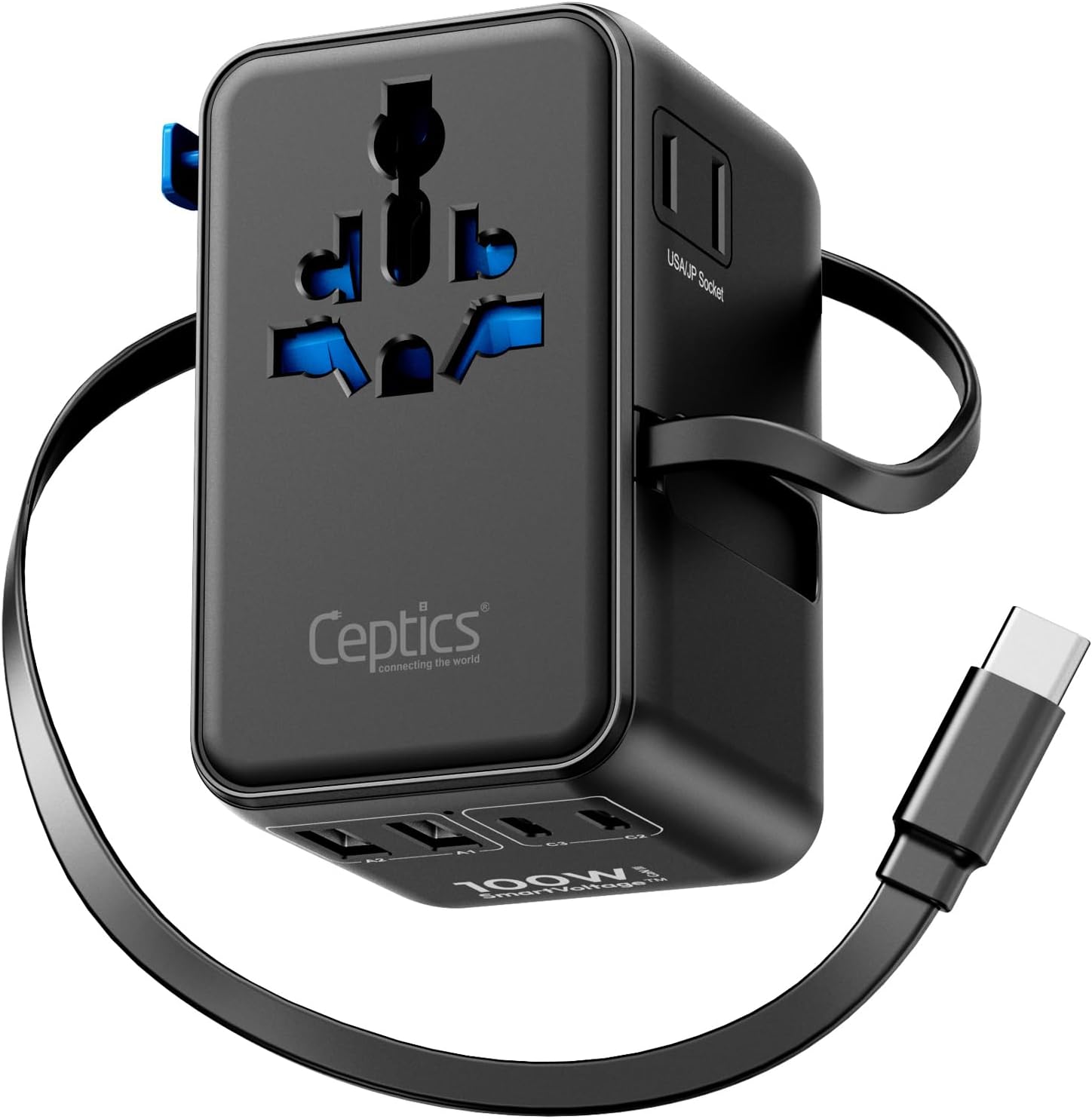
Ceptics Universal Travel Adapter
A convenient worldwide adapter for travelers who want Australia Type I support and a single charging solution for repeated international trips.
- Designed for Australia and other major plug regions
- Multi-device travel-friendly design
- Strong fit for frequent and business travelers
Availability and product details may change on Amazon.
How to Verify Your iPhone Charger Is Ready for Australia
Turn your iPhone charger over and examine the flat face or sides of the adapter body. Apple prints all electrical specifications in small text directly on the charger surface. Use good lighting — the text is small but always present on genuine Apple products. If there is no specification label at all, your charger may be counterfeit.
Look for the line beginning with “Input:” and check the voltage specification. On every genuine Apple iPhone charger, this reads “100–240V ~ 50–60Hz.” This range confirms your charger handles Australia’s 230V / 50Hz system automatically. If your charger shows only “110V” or “120V,” do not use it in Australia — it is not suitable.
Check for CE, UL, or other safety certification marks on the charger body. Genuine Apple chargers always carry these. In Australia, Apple chargers sold locally carry the Australian RCM safety mark. If your US Apple charger has no certification marks, treat it with caution — it may be a counterfeit product.
Once you confirm your charger is rated 100–240V, buy a Type A to Type I adapter before your trip. These are widely available at electronics stores, travel sections of department stores, and online retailers. Look for one clearly labeled “for Australia and New Zealand” or showing the Type I angled-prong design.
Always pack your plug adapter in your carry-on, not checked luggage. A delayed checked bag means no charging ability when you land after a 14–17 hour flight from the US to Australia. I keep my adapter clipped to my charging cable pouch so I never accidentally leave it behind.
Australian Charging Compatibility at a Glance
Do Third-Party iPhone Chargers Work in Australia?
Most quality third-party chargers from reputable brands — Anker, Belkin, Ugreen — are also rated 100–240V and work perfectly in Australia. Verify using the same method: read the input specification label directly on the charger body itself.
The genuine risk comes from cheap, uncertified chargers. I have tested budget chargers that listed “100–240V” on their packaging and online product pages but showed only “110V” on the actual label printed on the adapter. In Australia’s 230V outlets, a 110V-only charger would be destroyed immediately and could cause a fire or electrical damage to the outlet.
| Charger Type | Dual Voltage? | Safe for Australia? | Action Required |
|---|---|---|---|
| Genuine Apple 5W USB-A adapter | Yes — 100–240V | Yes | Buy Type I adapter only |
| Genuine Apple 20W USB-C adapter | Yes — 100–240V | Yes | Buy Type I adapter only |
| Genuine Apple 30W/35W USB-C adapter | Yes — 100–240V | Yes | Buy Type I adapter only |
| Reputable brand (Anker, Belkin, Ugreen) | Very likely — verify label | Verify first | Check label, then buy Type I adapter |
| Cheap no-name charger | Uncertain — may be 110V only | Only if label confirms 100–240V | Check label carefully — never assume |
| Counterfeit Apple charger | Unreliable — do not trust | Do not use | Replace with genuine Apple charger before traveling |
Before any international trip, photograph the specification label on every charger you plan to bring. Keep the photo on your phone. If you ever need to buy a replacement charger while traveling, you can show the photo to a local store employee and they will know exactly what specification you need. This is especially useful in Australia where local Apple chargers are sold but may look slightly different from the US version.
Charging All Your Apple Devices in Australia
The same universal voltage rules apply to every Apple device you might bring to Australia. MacBook chargers, iPad adapters, and AirPods charging cases are all rated 100–240V for the same reason as iPhone chargers — Apple designs all its charging equipment for global use.
For each device, the solution is identical: confirm the 100–240V label on the charger and use a Type A to Type I adapter. One adapter per charger body. The cables connecting the charger to your devices do not need any modification at all.
Some hotels in Australia — particularly major international hotel chains in Sydney, Melbourne, and Brisbane — have rooms with multi-region outlets that include a universal socket accepting several plug types, including US-style plugs. However, you should never count on this being available. Standard Australian outlets are all Type I. Always pack your adapter and treat any universal hotel outlet as a bonus rather than your plan.

UGREEN 65W Max 4-Port Universal Travel Adapter
A practical premium choice for charging an iPhone, Apple Watch, AirPods, iPad, and many USB-C laptops without carrying several separate wall adapters.
- Up to 65W output with four charging ports
- Australia-compatible worldwide travel design
- Ideal for several Apple devices
As an Amazon Associate, we may earn from qualifying purchases.
Pros and Cons of Using Your US iPhone Charger in Australia
- No voltage converter needed — saves money, weight, and space
- Identical charging speed to home — no performance difference
- Familiar charger you already own and trust
- One inexpensive Type I adapter handles all of Australia and New Zealand
- Works in every standard Australian outlet with the correct adapter
- No settings, switches, or adjustments of any kind required
- Type I adapter is mandatory — your charger cannot plug in without it
- Australian adapter does not fit European, UK, or Asian outlets
- Third-party chargers must be label-verified before use
- Forgetting the adapter on a 14–17 hour flight is a very long way to go without charging
- Some budget accommodations may have limited outlet access in rooms
Australia Trip iPhone Charging Checklist
- Check the input label on your charger — confirm it reads 100–240V and 50–60Hz
- Buy a Type A to Type I plug adapter before leaving home
- Pack charger and adapter in your carry-on — not checked luggage
- Bring a backup USB-C or Lightning cable in case your primary cable fails
- Consider a power bank for the long flight and travel days in Australia
- Do not pack a voltage converter — it is completely unnecessary
- If visiting New Zealand on the same trip, your Type I adapter works there too
- Charge your iPhone to 100 percent at the airport before boarding your flight
Troubleshooting: iPhone Not Charging in Australia
| Problem | Most Likely Cause | Fix |
|---|---|---|
| Cannot plug in at all | Wrong adapter type or no adapter | Confirm you have a Type A to Type I adapter — not a European or UK type |
| Charger buzzes, sparks, or smells burnt | Charger is single voltage — overloaded by 230V | Unplug immediately. Stop using it. Replace with a certified 100–240V charger |
| Nothing happens despite correct adapter | Loose adapter fit or outlet fault | Reseat adapter firmly in the outlet. Try a different outlet in the room |
| iPhone shows “Not Charging” | Loose cable connection or USB port issue | Check cable connection at both ends. Try a different outlet with wall adapter |
| Charging very slowly | Plugged into hotel TV or desk USB port | Use the wall outlet directly with your charger — not USB ports on electronics |
| Adapter wobbles in Australian outlet | Poor quality or incorrect adapter | Replace with a better-fitting Type I adapter. A loose fit is unsafe |
| Charger extremely hot during use | Poor quality charger or voltage mismatch | Unplug immediately. Verify label reads 100–240V. Replace if any doubt |
On long-haul flights to Australia — typically 14 to 17 hours from the US West Coast — your iPhone battery will need charging during the flight. Most modern aircraft have USB-A or USB-C seat power outlets. Bring your cable and a small GaN charger so you land with a full battery. Then your Type I adapter is ready to use the moment you check into your accommodation, even if you are exhausted from the flight.
Safety: Charging Your iPhone in Australia the Right Way
Always verify the 100–240V input rating on your charger before plugging into any Australian outlet. Plugging a 110V-only charger into Australia’s 230V outlets will destroy it immediately and can create a fire or electrical hazard. Never use a cracked or damaged plug adapter — a broken adapter can arc inside the outlet and cause electric shock. Do not force any adapter into an outlet that does not accept it cleanly — forcing an incorrect adapter risks damaging both the outlet and your equipment. Always charge on a hard open surface away from bedding and water. For authoritative information on charging safety standards, Battery University provides excellent guidance on lithium-ion battery charging safety that applies globally.
Key Takeaways
- Yes — iPhone chargers work in Australia. All genuine Apple chargers are rated 100–240V and handle Australia’s 230V automatically.
- You do not need a voltage converter — the Apple charger handles voltage conversion internally.
- You must have a Type A to Type I plug adapter — without it your charger cannot connect to any Australian outlet.
- The same Type I adapter works in New Zealand on the same trip.
- Always verify the voltage label on your charger body before traveling — especially with third-party chargers.
- Pack your adapter in your carry-on to avoid a very long trip with no way to charge.
- Cheap uncertified chargers may falsely claim dual voltage — always check the physical label.
Frequently Asked Questions
Yes. iPhone chargers work in Australia. All genuine Apple iPhone chargers are rated 100–240V, which means they automatically handle Australia’s 230V electricity with no voltage converter required. The only accessory you need is a Type A to Type I plug adapter to change the physical prong shape so your US charger fits into Australian wall outlets.
You need a Type A to Type I plug adapter for Australia. Australia uses Type I sockets with two or three flat angled prongs in a V-shape arrangement. US chargers have Type A flat parallel prongs that will not fit Australian outlets. A Type A to Type I adapter changes the physical prong configuration so your US charger connects to Australian sockets. This same adapter also works in New Zealand.
No. You do not need a voltage converter for a genuine Apple iPhone charger in Australia. All Apple chargers include internal switching technology that automatically handles any voltage between 100V and 240V, including Australia’s 230V standard. A voltage converter is bulky, expensive, and completely unnecessary. You only need a small plug adapter for the physical prong shape.
Yes. Your iPhone charges at exactly the same speed in Australia as it does at home in the US. The plug adapter only changes the physical prong shape and has zero effect on voltage, wattage, or charging speed. A 20W Apple charger delivers 20W in Australia just as it does in the US. Fast charging on supported iPhone models works exactly as normal.
Yes. New Zealand uses the same Type I socket as Australia. If your trip includes both countries, you only need one Type A to Type I adapter that works identically in both. New Zealand also uses 230V at 50Hz, which is handled automatically by your Apple charger just as in Australia.
No. European adapters are designed for Type C, E, or F sockets with two round pins. Australian outlets use Type I sockets with angled flat prongs. These are completely different and incompatible. A European adapter will not fit an Australian outlet. You need a specifically labeled Type A to Type I adapter for Australia and New Zealand travel.
Yes. Charging your iPhone overnight in an Australian hotel is completely safe when using a genuine Apple charger or a certified third-party charger rated 100–240V with the correct Type I adapter. Apple chargers include built-in overcharge protection and thermal management. Always charge on a hard open surface, keep the charger away from water, and use a properly fitting adapter. Australia’s electrical infrastructure is modern and reliable.
Yes. All genuine Apple chargers — including MacBook USB-C adapters and iPad chargers — are rated 100–240V and work in Australia with a Type I plug adapter. The same Type A to Type I adapter works for all your Apple chargers. Each charger body needs its own adapter, but the cable connecting the charger to your device requires no modification at all.
Conclusion
Which Travel Adapter Should You Buy?
Choose by the devices you plan to carry. All three options solve the Australian plug-shape problem, but their strongest use cases differ.
After charging iPhones across Australia on multiple trips, the answer is definitive: yes, your iPhone charger works perfectly in Australia. The 100–240V universal voltage support built into every genuine Apple charger means Australia’s 230V electricity is handled silently and automatically. You do not need a voltage converter, a special charger, or any electrical expertise.
The one non-negotiable item is a Type A to Type I plug adapter. Australia’s angled V-shape sockets accept nothing else. Buy your adapter before you leave home, pack it in your carry-on, and you are completely prepared to charge your iPhone anywhere across Australia. If your trip also covers New Zealand, the same adapter works there too.
Stay safe by always reading the voltage label on any charger before you travel, using a well-fitting quality adapter, and charging on open surfaces away from water and bedding. For more information on iPhone battery care and safe charging practices globally, Apple Support is the most accurate and up-to-date resource available.
iPhone chargers work perfectly in Australia — buy a Type A to Type I plug adapter before you fly, confirm your charger label reads 100–240V, and your iPhone will charge at full speed anywhere in Australia and New Zealand with no voltage converter needed.