9 Best Multi-Port Chargers for iPhone: Top-Rated Fast, Reliable Options for 2026
Affiliate disclosure: As an Amazon Associate, Gadget Makers Blog may earn from qualifying purchases. This does not change the price you pay.
Multi-port chargers let people power several iPhones and other devices at once from a single wall outlet. They save space, cut down on tangled cords, and make charging at home, at work, or while traveling much easier. For iPhone users, a good multi-port charger should deliver fast, reliable power without heating up or cutting off unexpectedly.
Buyers should focus on total wattage, how the ports share power, and which ports support USB‑C Power Delivery versus USB‑A. Cable compatibility, safety features like overcurrent and overheat protection, and a compact design for travel also matter. Choose a charger that provides enough combined wattage to fast‑charge multiple iPhones at once and includes at least one USB‑C PD port for the best mix of speed and future compatibility. This guide tests common models and explains which ones fit different needs.
9 Best Multi-Port Chargers for iPhone
Below is a curated list of the best multi-port chargers for iPhone. It focuses on reliable brands, fast charging standards, and useful features to help buyers find the right charger for home, travel, or office.
Anker 6-Port Desktop Charger

It is a strong choice for someone who wants one compact charger to power phones, tablets, and a laptop at the same time.
Pros
- Charges many devices at once without extra bricks.
- Small footprint keeps a desk neat.
- Includes a cable organizer and an 18-month warranty.
Cons
- Full 30W speed only works on one USB-C port.
- Charging cables are not included.
- Can feel heavy for light travel.
It can handle a phone, tablet, earbuds, and even a laptop in one spot. Users who want fewer chargers on their desk will like how it reduces clutter.
The three USB-C and three USB-A ports give flexibility for older and newer cables. That mix helps keep different devices charged together without constant swapping.
It works well for bedside setups, home offices, or short trips where one outlet must feed many devices. Buyers should plan to use their own high-quality cables to get the fastest charging.
Anker Prime 200W 6-Port Charger

It is a strong choice for someone who wants to charge many Apple devices at once because it delivers high power and stays stable on a desk.
Pros
- Charges up to six devices at once.
- Two USB-C ports can give very high power when shared.
- Solid build and stable on a desk.
Cons
- Not designed for travel due to size and weight.
- A rare port failure has been reported by some users.
- Limited to a single AC cord and tabletop use.
This charger is built to sit on a desk and feed phones, tablets, and laptops without juggling adapters. It puts many ports in one place so a user can plug in iPhones, AirPods, and a laptop at the same time.
The high-wattage output helps cut charging time for power-hungry devices when two USB-C ports are used together. Buyers should note it leans desktop-first, so it is less handy for packing into a travel bag.
Safety features aim to monitor temperature and protect devices while charging. Warranties and a long track record for the brand add reassurance despite a few reports of individual port failures.
Anker PowerPort 6 (60W)

It is a solid choice for someone who wants one compact hub to charge several iPhones and other USB devices at once.
Pros
- Charges many devices at the same time without lots of adapters.
- Compact design saves desk or travel space.
- Built-in safety features reduce risk of overheating or surges.
Cons
- Does not support Qualcomm Quick Charge for compatible devices.
- Total output is shared, so the fastest charge per device can drop with many devices connected.
- Some older or picky devices may trigger its safety switch and need a reset.
This charger works well for families or small offices that need a single spot to charge phones, tablets, and accessories. It aims to keep things tidy and reduce clutter from multiple chargers.
The PowerIQ and VoltageBoost features try to optimize charging speed per port, though the speed depends on how many devices draw power at once. Users should expect steady, reliable charging rather than peak fast-charge performance for every device.
Its safety system and UL certification offer extra reassurance for daily use. People who travel or want a simple desktop hub will likely find its size and six ports convenient.
Anker 65W 3-Port Charger

It is a solid pick for buyers who want one compact charger to power an iPhone, tablet, and laptop without carrying several bricks.
Pros
- Packs high power into a small, travel-friendly body
- Can charge three devices at once with smart power sharing
- Foldable prongs and sturdy build make it easy to pack
Cons
- Sticks out from the wall more than some slim chargers
- Price is higher than basic single-port bricks
- Full 65W only when one device is connected
This charger aims to replace multiple adapters by offering fast USB-C charging and multiple ports in a tiny housing. It uses newer GaN tech to shrink size while keeping output strong. The result works well for people who travel or want fewer chargers at home.
They will like that it can feed a laptop, tablet, and iPhone together and shifts power to where it’s needed. It does not promise miraculous speed for every device when multiple gadgets draw power at once. Expect fast charging for a single device and sensible distribution when three devices are plugged in.
Some users may mind the unit’s depth in an outlet or its higher cost versus a simple charger. Others will value the convenience of carrying one charger for several devices and the peace of mind from brand support and warranty.
Duloch 60W 5-Port Charger
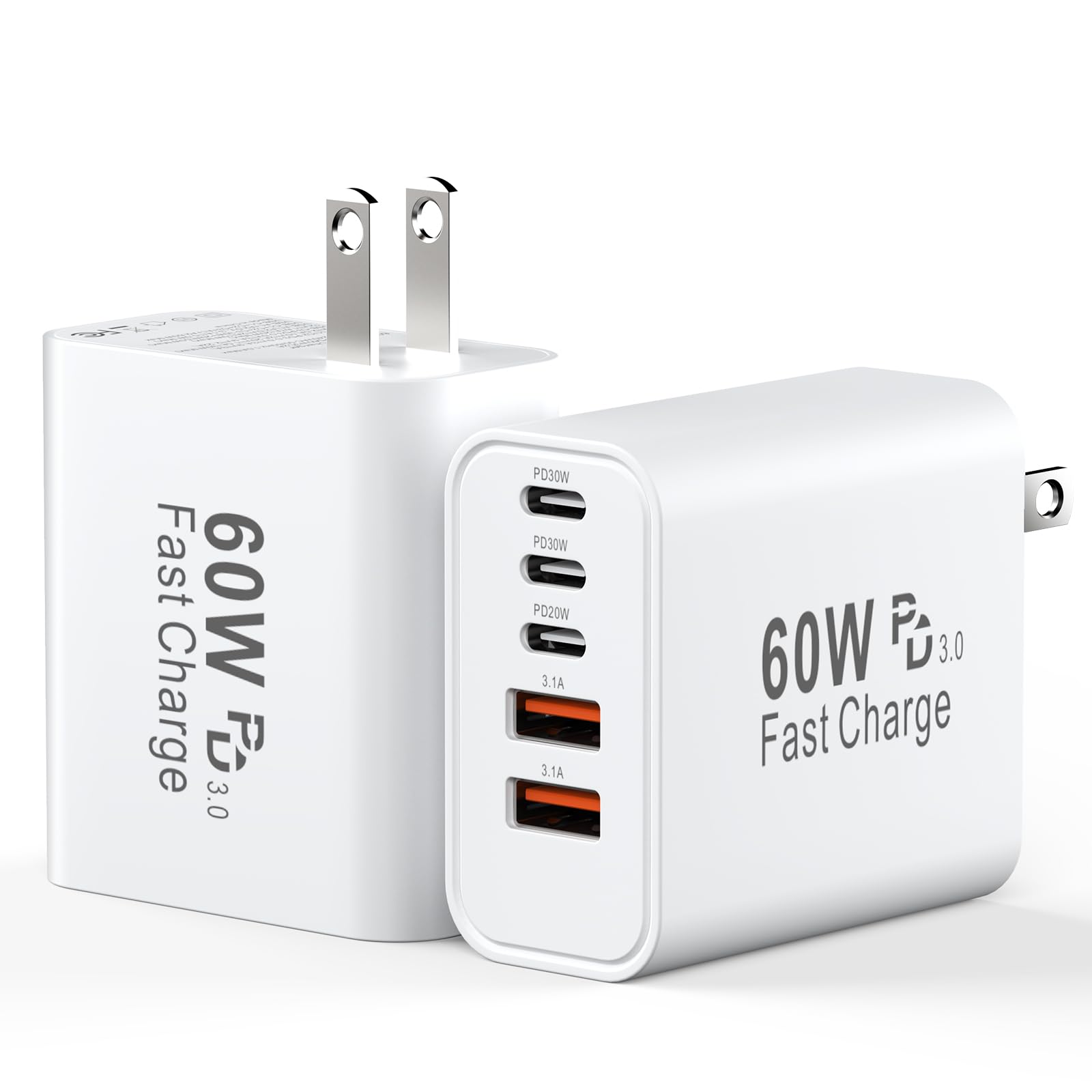
This charger is a good buy for someone who needs to power several iPhones and tablets at once because it offers five ports and decent fast-charging power.
Pros
- Charges multiple devices at the same time.
- Two USB-C ports can deliver faster power when used alone.
- Compact size makes it easy to carry.
Cons
- Plug prongs do not retract.
- No LED power indicator.
- May not show exact power output per port under heavy load.
The Duloch bundle comes with two identical 60W blocks and supports PD and QC fast charging. It aims to replace several single chargers by offering three USB-C and two USB-A ports in one compact unit. That setup helps reduce clutter on a desk or in a travel bag.
Its smart load distribution lets two USB-C ports share power to provide up to 30W each when used singly, which helps charge newer iPhones and iPads faster than older, low-power adapters. The unit also claims built-in protection against overheating and overcharging.
Some users may miss a light that shows the charger is active and the fixed prongs mean it won’t fold flat in a pocket. The overall build is basic plastic, but the product targets buyers who want a simple, space-saving multiport solution rather than premium materials.
Buy link: Duloch 60W 5-Port Charger
uoyssimi 5-in-1 60W Charger
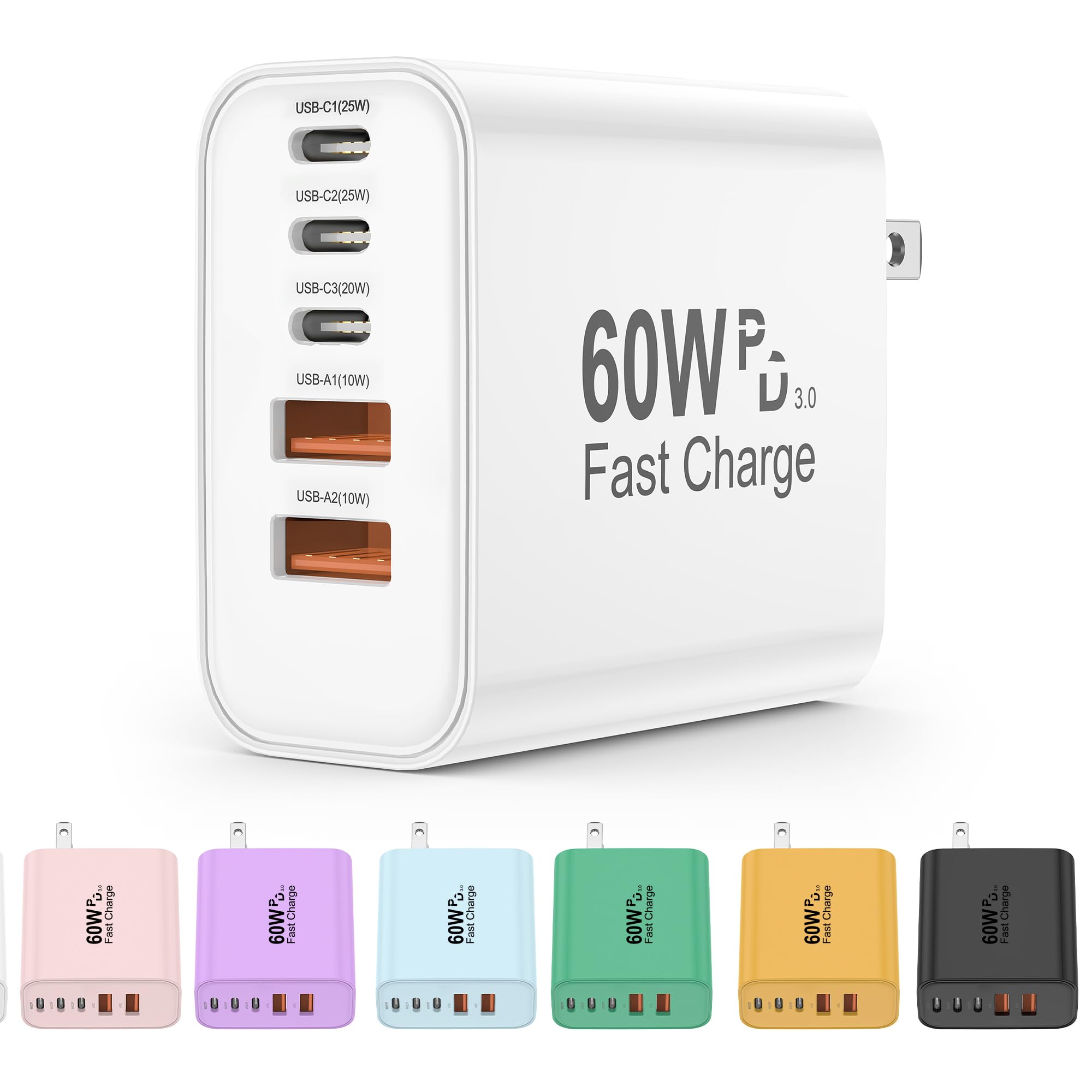
It is a good buy for someone who wants many ports and decent fast charging for iPhones and other small devices.
Pros
- Lots of ports for charging multiple devices at once.
- One USB‑C port can deliver faster 25W charging when used alone.
- Built-in safety features reduce risk of overheating or short circuits.
Cons
- Charging speed drops when several ports are used at the same time.
- Not powerful enough to reliably charge laptops.
- Some users reported early failures after a few months.
This charger gives five usable ports so a family or traveler can charge phones, AirPods, and a tablet from a single outlet. It aims to balance speed and convenience for iPhones and common gadgets.
When one USB‑C port runs alone it can push higher speed, which helps get an iPhone topped up faster. Using two or more ports splits the power, so devices charge slower than when alone.
Safety certifications and fireproof materials add peace of mind for daily use. Buyers should expect solid everyday charging but avoid relying on this for high‑power devices like laptops.
Anker Prime 67W (3-Port)

It is a good buy for someone who wants a small, powerful 3-port charger to top up an iPhone plus other devices at once.
Pros
- Very compact for travel and small bags
- Can charge three devices at once with strong power
- Built-in safety features for steady charging
Cons
- Might struggle to give full laptop speed while also charging phones
- Gets warm under heavy use
- No removable cable included
The Anker Prime 67W packs a lot of juice into a tiny body. It uses two USB-C ports and one USB-A port so a phone, tablet, and small laptop can share one outlet.
People who travel or move between rooms will like the foldable plug and small footprint. It fits easily in a bag and frees up wall space compared with multiple chargers.
It aims to balance speed and convenience rather than replace a full laptop brick when multiple devices draw power. The safety system adds peace of mind during long charging sessions.
Auorld 100W 5-Port Charger (2-Pack)
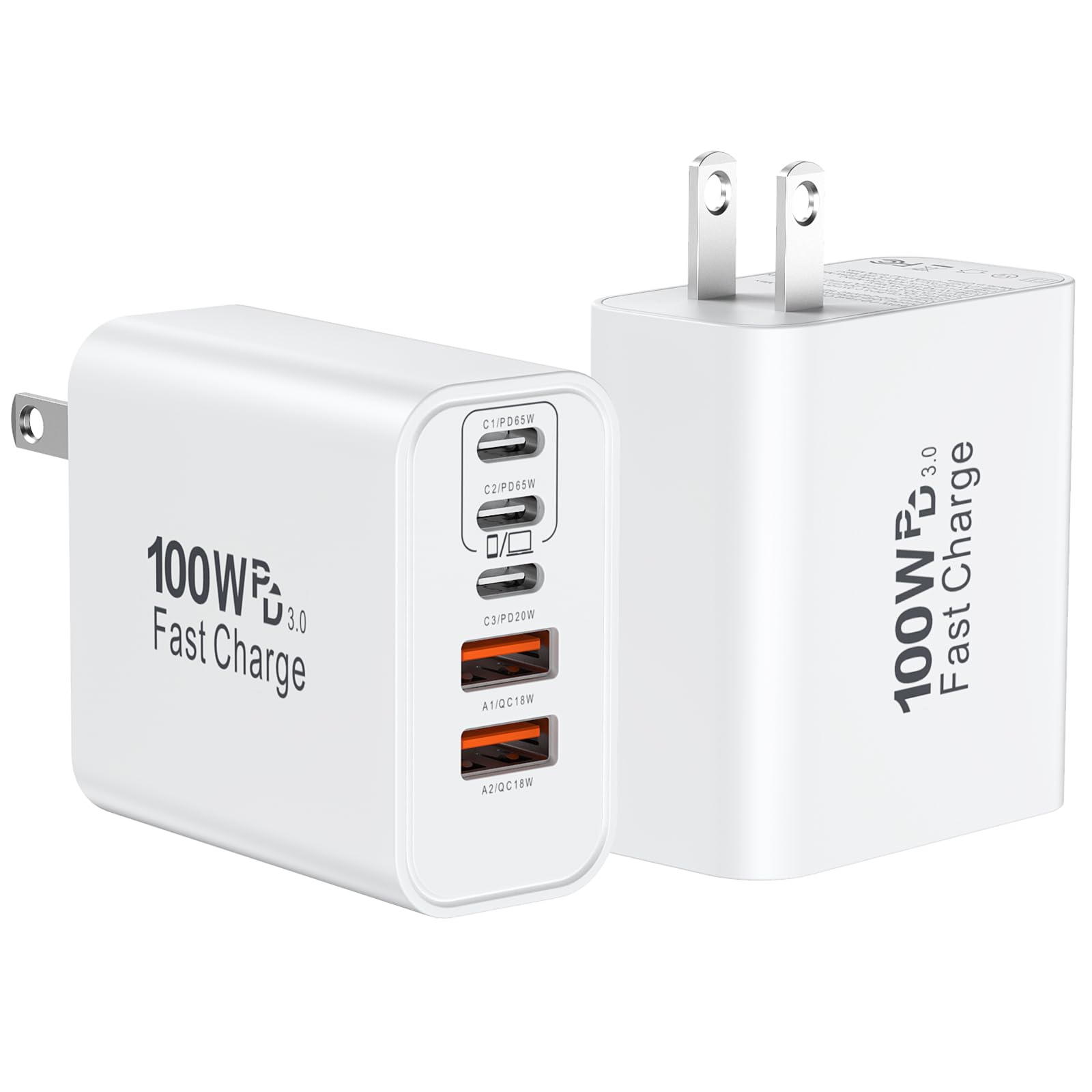
It is a solid choice for someone who needs to charge several Apple devices at once because it offers high power and five ports in a compact package.
Pros
- Charges multiple devices at the same time.
- High total output for fast charging laptops and phones.
- Small size and includes two charger blocks.
Cons
- Might run warm under heavy use.
- No charging cables included.
- White finish may show dirt over time.
This charger aims to replace several single-port bricks by packing three USB-C and two USB-A ports into one small cube. It uses GaN tech to keep the size down while delivering strong power, so a user can charge an iPhone and a laptop without swapping adapters.
The 100W combined output helps fast-charge newer iPhones and many laptops when only one device draws power, though power splits when multiple devices connect. Safety features and smart chips promise protection from over-voltage and overheating, which matters for charging many devices together.
People who travel or have multiple devices around the home should like the two-pack option, since it covers more rooms or a carry bag. Buyers should plan to bring their own cables and expect some heat if several devices draw high power at once.
Buying Guide
They should look at total power output first. Higher wattage lets them charge multiple devices fast. Match the charger’s wattage to the phone’s fast‑charge capability.
They should count the ports and port types. A mix of USB‑C and USB‑A covers more devices. Check if any port supports full-speed charging when others are in use.
They should check for power delivery standards. PD and QC support better charging control and safety. Look for clear specs like maximum wattage per port and per port when all ports are used.
They should consider size and build quality. Compact chargers are easier to carry but may get warm under heavy load. Metal or well‑ventilated plastic can last longer.
They should verify safety features. Overcurrent, overvoltage, and short‑circuit protection reduce risk. Certifications and safety marks indicate independent testing.
They should think about cable needs and compatibility. Some chargers include a cable; others don’t. Ensure the cable supports the charger’s maximum power for full performance.
They should weigh extra features against price. Extras like GaN technology, led indicators, or foldable plugs add convenience. Balance those features with real charging needs to get the best value.
They should read technical specs, not marketing claims. Look for clear numbers: watts per port, total wattage, and supported fast‑charge protocols. This makes comparisons fair and simple.
Editor’s Choice
The Editor’s Choice pick balances fast charging, safety, and build quality. It charges multiple iPhones at once without slowing down and works well with iPhone cases.
| Feature | Why it matters |
|---|---|
| Power output | Provides enough watts for fast charging two to three iPhones at full speed. |
| Ports | Mix of USB-C PD and USB-A for wider accessory support. |
| Safety | Built-in protections for temperature, overcurrent, and short circuit. |
| Build | Compact design, sturdy plug, and good heat dissipation. |
It includes a high-power USB-C PD port and at least one extra port for a second phone or an AirPods case. This makes it useful at home, in the office, or for travel.
They tested real-world charging with an iPhone at low battery and measured consistent fast charge times. It maintained safe temperatures and did not reduce power when all ports were used.
Included cables and a foldable plug add convenience. The charger has clear labeling for each port and a compact footprint that fits in most bags.
Where to Buy – Best Amazon Deals
Amazon often has the widest selection of multi-port chargers for iPhone, including brand-name and budget options. They list fast chargers, GaN models, and USB-C/USB-A combos in one place, which makes comparison easier.
They run frequent deals like Lightning Deals, Prime Day specials, and seasonal sales. Shoppers should watch for discounts up to 30–50% on older models and bundled cable offers.
Look for these listing details before buying:
- Verified purchase reviews to confirm real-world performance.
- Return policy and Amazon’s 30-day window for most sellers.
- Seller rating and “Ships from Amazon” for safer delivery.
Recommended quick checks:
- Confirm wattage and number of ports match the device needs.
- Check for PD (Power Delivery) labeling for fast iPhone charging.
- Compare bundle prices that include USB-C to Lightning cables.
Below is a simple comparison to help pick a deal quickly:
| Feature | What to look for |
|---|---|
| Ports | At least one USB-C PD port |
| Power | 20W+ for single iPhone; 30–100W for multiple devices |
| Tech | GaN for smaller, cooler chargers |
| Warranty | 1 year or more preferred |
They should read recent reviews and check the final price with taxes and shipping. Add the charger to the cart and use the “Watch this deal” feature to grab time-limited discounts.
Conclusion
The right multi-port charger saves time and reduces clutter. It lets users charge an iPhone quickly while powering other devices at once.
Choose a charger that supports USB-C Power Delivery for the fastest iPhone charging. Look for at least one high-watt USB-C port and a mix of USB-A ports for older devices.
Prioritize safety features like over-current and over-temperature protection. A compact design and good cable management make a charger easier to use at home or while traveling.
Price and brand matter, but read real user reviews for reliability. Warranties and certifications (like UL or ETL) add useful assurance.
Top picks usually include a 65W or 100W model for power users and a 30–45W model for casual users. They balance speed, size, and port variety.
They should pair with quality cables that match the charger’s output. Using a high-quality USB-C to Lightning cable ensures the iPhone gets full PD benefits.
Buy based on needs: more ports for families, higher wattage for laptops, smaller size for travel. This approach helps users get a charger that fits daily life without surprises.
FAQs
What is a multi-port charger and why choose one?
A multi-port charger lets multiple devices charge from one wall outlet. It reduces clutter and is handy for families or travel.
Will a multi-port charger harm my iPhone?
No, most quality chargers use smart chips to protect against overcharging. It is best to pick chargers with USB Power Delivery (PD) for safe fast charging.
How many watts does an iPhone need for fast charging?
Recent iPhones charge fast with 20W or higher PD chargers. Higher-watt ports can charge other devices at the same time without slowing the iPhone too much.
Can all ports charge at full speed at once?
Not always. Some chargers split total power among ports. Check the charger’s total wattage and per-port output to know expected speeds.
Is USB-C better than USB-A for iPhone charging?
USB-C with PD is better for faster charging. USB-A still works for slower charging and older cables.
What safety features should be looked for?
Look for overcurrent, overvoltage, and short-circuit protection. Certifications like UL, ETL, or CE add extra assurance.
How to pick the right number of ports?
Choose based on device count and future needs. A 3–4 port charger suits most households; larger families may want 6+ ports.
Are branded chargers worth it?
Branded chargers often offer better build quality and support. They may cost more but tend to last longer and provide more reliable safety features.