20W vs 65W Charger: Anker 20W vs Anker Nano II 65W Compared
Affiliate disclosure: As an Amazon Associate, Gadget Makers Blog may earn from qualifying purchases. This does not change the price you pay.
20W vs 65W charger is mainly a choice between simple phone charging and much more flexible USB-C power. The Anker 20W charger bundle is a practical fit for phones and small devices, while the Anker Nano II 65W is designed to handle phones, tablets, and many compatible USB-C laptops from one compact charger.
Choose the Anker 20W charger if you mainly charge an iPhone, AirPods, or other small devices and want a simple setup. Choose the Anker Nano II 65W if you also charge a USB-C laptop, tablet, larger power bank, or Samsung phone that can use more charging power. For an iPhone alone, 65W does not mean the phone will take the full 65W.
Best for phones and everyday charging: Anker 20W. The B0C8HHV9DK package gives you two 20W chargers and two USB-C cables, making it useful for a bedroom, office, or travel bag.
Best overall for power users: Anker Nano II 65W. Its single USB-C port can deliver up to 65W, and Anker specifically lists compatible notebooks such as the MacBook Air, 13-inch MacBook Pro, Dell XPS 13, and other USB-C laptops.
My pick for long-term flexibility: 65W. If you own only a phone, 20W is enough for many common charging needs. If you want one compact adapter that can move between your phone, tablet, and laptop, the Nano II 65W is much more capable.
Best for iPhone and everyday phone charging. The package includes two charger blocks and two 5-foot USB-C cables.
Check Anker 20W on AmazonBest for users who want one compact GaN II charger for phones, tablets, and compatible USB-C laptops.
Check Anker 65W on Amazon20W vs 65W Charger: What Is the Real Difference?
The number on a charger tells you its maximum available output. It does not mean every connected device will use that much power.
The Anker 20W model has a maximum USB-C output of 20W when one compatible device uses that port. The Anker Nano II can deliver up to 65W through its single USB-C port.
That gives the Nano II 45W more maximum power.
But extra power matters only when your device can use it.
Anker 20W vs Anker Nano II 65W Specifications
| Feature | Anker 20W | Anker Nano II 65W |
|---|---|---|
| ASIN | B0C8HHV9DK | B08T5QN2TR |
| Model | A2348 | A2663 |
| Maximum Output | 20W USB-C | 65W USB-C |
| USB-C Ports | 1 | 1 |
| USB-A Ports | 1 | 0 |
| Single USB-A Output | Up to 18W | Not applicable |
| Both Ports in Use | 15W total | Not applicable |
| GaN II | Not listed for this model | Yes |
| Foldable Plug | No | Yes |
| Input | 100–240V | 100–240V |
| Best For | Phones and small devices | Phones, tablets and compatible laptops |
| Cables in This Amazon Bundle | Two 5-ft USB-C cables | Cable sold separately |
The 20W product in this comparison is Anker model A2348. It has one USB-C port and one USB-A port. When used alone, USB-C can provide up to 20W and USB-A up to 18W. When both ports are active, the total listed output is 15W. The Nano II 65W is model A2663 and has one USB-C port.
Anker 20W Charger: Best for Simple Everyday Charging
The Anker 20W is the easier choice for a phone-first setup.
It is especially interesting because the Amazon listing you selected is a two-pack. It also includes two 5-foot USB-C cables.
That gives you several placement options. You could keep one charger by your bed and another at work. You could also leave one in your travel bag.
The charger has both USB-C and USB-A. This can be handy if you still own older USB-A cables.
With one device connected, its USB-C port supports up to 20W. Its USB-A port supports up to 18W.
There is an important limitation, though.
If you connect devices to USB-C and USB-A at the same time, the total output drops to 15W. So this is not a 20W-per-port charger.
If fast phone charging matters most, connect only your main phone while you need the fastest supported output. Using both ports changes the available power on this charger.
Who Is the Anker 20W Best For?
- iPhone users who mainly need phone charging.
- People who want USB-C and USB-A on one adapter.
- Users who need chargers in two locations.
- Travelers with small USB-powered devices.
- People who do not need laptop-class charging power.
Anker Nano II 65W: Best for More Demanding Devices
The Nano II 65W solves a different problem.
It has only one USB-C port, but that port can supply up to 65W.
Anker lists its output profiles as 5V/3A, 9V/3A, 15V/3A, and 20V/3.25A, with a maximum output of 65W.
That makes it far more suitable for higher-power USB-C devices.
Anker specifically lists support for devices such as the MacBook Air 2020, 13-inch MacBook Pro, Dell XPS 13, ThinkPad X390, Google Pixelbook, and several other notebooks.
The Nano II also uses GaN II technology. Anker uses gallium nitride technology to deliver high output from a compact charger body.
The official dimensions are 1.65 × 1.42 × 1.74 inches, and the listed weight is 3.96 ounces.
You can review the current specifications on :contentReference[oaicite:0]{index=0}.
Who Is the Anker Nano II 65W Best For?
- USB-C laptop users.
- People who charge a laptop and phone with the same adapter at different times.
- Tablet users who want more charging headroom.
- Travelers trying to replace several adapters with one.
- Users who want more flexibility for future USB-C devices.
I would not buy the Nano II 65W only because 65 is a bigger number. Its value appears when your charging setup includes devices beyond a phone. If I were packing an iPhone plus a USB-C laptop, I would much rather carry the 65W model.
Which One Charges an iPhone Faster?
This is where charger comparisons can become misleading.
A 65W adapter does not automatically send 65W to an iPhone.
The phone and charger work together to establish a supported charging level. The phone does not simply absorb the maximum number printed on the charger.
For many phone-focused situations, the Anker 20W can therefore make more sense than buying 65W solely for an iPhone.
The 65W model becomes valuable because it can also serve higher-power devices.
Moving from a 20W charger to a 65W charger does not mean your phone will charge 3.25 times faster. Your device, battery level, temperature, cable, and supported charging protocol all affect real charging speed.
20W vs 65W Charger for iPhone
If your setup revolves around an iPhone, I would start with the 20W option.
It is designed around the power range that makes sense for phone charging, and this specific bundle gives you two chargers and cables.
The Nano II 65W can also charge compatible iPhones. Anker states that the Nano II supports iPhones and other handheld devices.
But its extra power is more useful when the same adapter also needs to charge a laptop or another higher-power USB-C device.
iPhone verdict: Buy 20W for an iPhone-focused setup. Buy 65W when you want one charger that can move between your iPhone and higher-power USB-C devices.
20W vs 65W for iPad and Tablets
Both chargers can work with compatible tablets.
The 20W model is a sensible choice for light tablet charging.
The Nano II has much more available power, so it is the stronger all-purpose option if a tablet is only one part of your device collection.
However, a tablet will still draw only the power supported by its charging system.
20W vs 65W for MacBook and USB-C Laptops
This is the easiest category to call.
The Nano II 65W wins.
The Anker 20W is primarily a phone and small-device charger. Twenty watts is not enough to replace the normal power adapter for many laptops.
The Nano II was built for much more demanding USB-C devices.
Anker specifically states that its 65W USB-C output can charge supported notebooks, including several MacBook, Dell, Lenovo, HP, Google, and Microsoft models.
| Device Type | Anker 20W | Anker Nano II 65W |
|---|---|---|
| iPhone | Excellent fit | Excellent fit, extra capacity may go unused |
| AirPods | Excellent | Excellent |
| Apple Watch Charging Accessory | Good | Good |
| iPad | Good for compatible models | More power headroom |
| Samsung Phone | Compatible use depends on model and protocol | Better fit for supported higher-power charging |
| Nintendo Switch | Device-dependent | Anker lists Switch compatibility |
| USB-C Power Bank | Good for lower-input models | Better for compatible higher-input models |
| MacBook Air | Too limited for many laptop-focused uses | Anker lists supported MacBook Air models |
| 13-inch MacBook Pro | Not the practical choice | Anker lists compatibility |
| Dell XPS 13 | Not the practical choice | Anker lists supported XPS 13 models |
What About Samsung Fast Charging?
The Nano II 65W has another advantage for some Samsung users.
Anker states that it supports Samsung Super Fast Charging on compatible devices.
There is an important limit. Anker notes that the Nano II 65W supports Super Fast Charging for the Galaxy S22 Ultra but does not support 45W Super Fast Charging 2.0.
That detail is a good example of why wattage alone is not enough.
A 65W charger may have plenty of raw power while a particular phone still requires a specific charging protocol for its maximum charging mode.
One Port vs Two Ports
This comparison has an interesting trade-off.
The cheaper-power 20W model actually gives you more ports.
It has one USB-C port and one USB-A port.
The Nano II 65W has only one USB-C port.
So, if you want to plug in two low-power devices at the same time, the 20W model gives you that option.
But remember the power-sharing limit. Using both ports on the A2348 reduces total output to 15W.
The Nano II cannot charge two devices at once because it has one port.
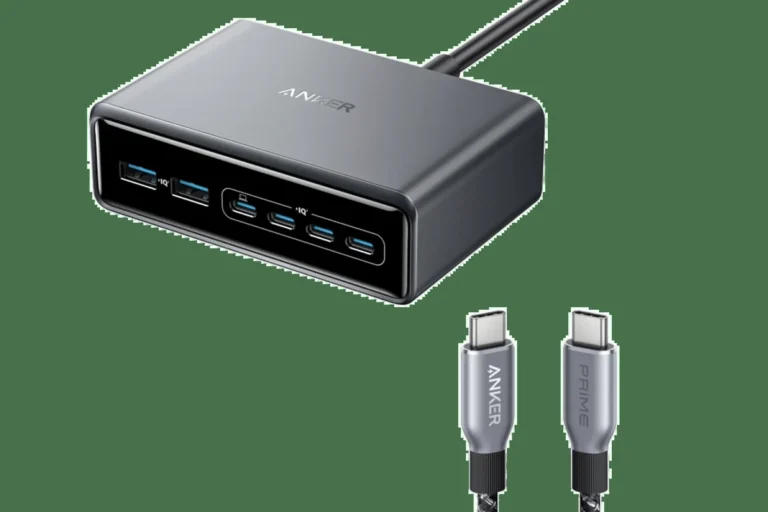
If you need 65W-class power and simultaneous multi-device charging, neither of these two products is the ideal match. You would want to compare a multi-port higher-wattage charger instead.
Charging Power Comparison
| Charging Situation | Anker 20W | Anker Nano II 65W | Better Choice |
|---|---|---|---|
| One iPhone | Up to 20W charger output | Up to 65W available | 20W for simplicity |
| One small accessory | More than enough for many accessories | Large unused power reserve | 20W |
| Phone + second USB device simultaneously | Possible, 15W total listed output | Not possible from one-port charger | 20W for two connections |
| Compatible tablet | Useful | More headroom | Depends on tablet |
| Compatible USB-C laptop | Very limited | Up to 65W | 65W |
| One charger for phone and laptop at different times | Limited | Excellent use case | 65W |
Does the 65W Charger Use More Electricity?
Not simply because it says 65W.
A 65W rating describes the charger’s maximum available output. It does not mean it constantly consumes 65 watts whenever it is plugged in.
The connected device’s needs and the charging process affect actual power use.
So, charging a low-power device from a 65W adapter does not mean the charger continuously sends 65W into it.
Is 65W Safe for a 20W Phone?
A compatible USB-C charging system does not work by blindly forcing maximum charger power into the device.
This is why a higher-capacity charger can be used with many lower-power devices when the standards and cables are compatible.
The Nano II also conforms to the IEC 62368-1 safety standard according to Anker.
The A2348 20W charger listing specifies compliance with UL 62368-1 and CSA C22.2 No. 62368-1 standards.
Stop using a charger or cable if you see cracked plastic, exposed wiring, damaged pins, melting, smoke, sparks, or a burning smell. Also avoid covering a charger while it is working, since normal charging creates heat that needs to escape.
Which Charger Is Better for Travel?
This depends on what is inside your bag.
If I were traveling with only a phone, earbuds, and a few small accessories, I would prefer the 20W bundle.
If I were carrying a USB-C laptop, the decision changes.
The Nano II 65W can replace a separate phone charger and a compatible laptop charger for many users. That can make a higher-wattage single-port charger more useful even if the adapter itself is more powerful than your phone needs.
Its foldable plug also helps when packing it in a small electronics pouch.
Think about how many adapters the charger can replace, not just its wattage. A 65W charger can be the lighter overall setup if it replaces both your phone and laptop adapters.
Cable Requirements
The cable is part of the charging system.
For USB-C devices, use a suitable USB-C to USB-C cable.
For older iPhones with Lightning, Anker says to use a USB-C to Lightning cable with the Nano II.
The 20W Amazon package you selected includes two USB-C cables. That is useful for USB-C devices, but Lightning-device owners should check which cable they need.
For higher-power devices, make sure the cable supports the required charging power and protocol.
20W vs 65W Charger Pros and Cons
- Good fit for phone charging.
- USB-C and USB-A ports.
- Two chargers in the selected Amazon package.
- Two 5-foot USB-C cables included.
- Useful for keeping chargers in different locations.
- Simple choice for users without a USB-C laptop.
- Not a practical replacement for many laptop chargers.
- Only 20W maximum through USB-C.
- Power drops when both ports are used.
- Less future-proof for higher-power USB-C devices.
- Up to 65W USB-C output.
- Suitable for many compatible notebooks.
- GaN II technology.
- Compact design.
- Foldable plug.
- Strong option for one-charger travel setups.
- More flexible for higher-power USB-C devices.
- Only one USB-C port.
- Cannot charge two devices at once by itself.
- Extra wattage may not speed up phone charging.
- Cable is sold separately according to Anker.
- Does not support Samsung 45W Super Fast Charging 2.0.
Which One Should You Buy?
- Mainly charge an iPhone or another phone.
- Want both USB-C and USB-A.
- Want two chargers from this package.
- Need extra USB-C cables.
- Do not need to charge a laptop.
- Want a simple charger for home, work, or travel.
- Own a compatible USB-C laptop.
- Want one adapter for a phone, tablet, and laptop at different times.
- Need more than 20W for other devices.
- Want a compact GaN II charger.
- Prefer a foldable plug for travel.
- Want more power headroom for future USB-C devices.
How to Pick Between 20W and 65W
Start with every device you want the charger to power. Include your phone, tablet, power bank, headphones, handheld console, and laptop.
Your laptop or tablet may need much more power than your phone. If one device benefits from around 65W, the Nano II becomes much more useful.
The Anker 20W has USB-C and USB-A. The Nano II 65W has one USB-C port. Pick based on how you actually charge.
Make sure your cable matches the device connector and supports the power level you want.
If 65W lets one charger replace separate phone and laptop adapters, the Nano II may simplify your travel kit.
Common Problems and Troubleshooting
| Problem | Possible Reason | What to Do |
|---|---|---|
| Phone charges slowly | Cable, device limit, temperature, or charging protocol | Check the cable and device charging specifications. |
| Anker 20W slows with two devices | Power is shared | Use one port when you need maximum output. |
| 65W is not faster on an iPhone | The phone cannot use all 65W | This can be normal. Check your phone’s supported charging rate. |
| Laptop reports slow charger | Device needs more power or a different profile | Check the laptop’s recommended USB-C input. |
| Samsung maximum mode does not appear | Protocol or cable limitation | Check the phone’s charging standard and cable requirements. |
| Device does not charge | Cable, port, outlet, or compatibility issue | Try another suitable cable and outlet, then inspect the charger. |
| Charger feels warm | Power conversion creates heat | Keep it uncovered and stop use if heat becomes extreme or unusual. |
My Final 20W vs 65W Charger Verdict
Best for iPhone users: Anker 20W. It provides a straightforward phone-charging setup, and the selected package includes two chargers and cables.
Best for basic home charging: Anker 20W. The USB-C plus USB-A layout gives it useful flexibility for small devices.
Best for laptop users: Anker Nano II 65W. This is the clear winner because Anker designed it to power many compatible USB-C notebooks.
Best for power users: Anker Nano II 65W. The extra 45W of maximum output greatly expands the types of devices it can handle.
Best for two low-power devices at once: Anker 20W. It has two ports, although total output falls to 15W when both are active.
Best for one-charger travel: Anker Nano II 65W. It makes the most sense when it can replace separate phone, tablet, and laptop adapters.
Best long-term choice: Anker Nano II 65W. If you expect your USB-C device collection to grow, the extra power provides much more room.
Recommended for: iPhone users, phone-focused charging, USB-C and USB-A accessories, and users who want two chargers.
View Anker 20W on AmazonRecommended for: USB-C laptop owners, power users, tablet users, and travelers who want one high-power adapter.
View Anker Nano II 65W on AmazonFrequently Asked Questions
A 20W charger is a practical choice for phones and small devices. A 65W charger is better if you also need to charge compatible USB-C laptops, tablets, or higher-power devices. The best choice depends on the devices you own rather than wattage alone.
Not necessarily. An iPhone does not automatically take the full 65W available from the charger. Its supported charging rate, battery level, temperature, cable, and charging protocol affect actual speed.
Yes, the Anker Nano II 65W is designed to work with compatible phones as well as higher-power devices. A compatible charging system negotiates the supported power rather than simply forcing the charger’s maximum 65W into the phone.
Yes. Anker model A2348 has one USB-C port and one USB-A port. However, its listed total output is 15W when both ports are used at the same time, so charging can be slower than when one device uses the charger alone.
Yes, Anker lists compatibility with several notebooks, including the MacBook Air 2020 and 13-inch MacBook Pro. Laptop power requirements vary, so check the recommended power input for your exact MacBook before replacing its original adapter.
No. The Anker Nano II 65W model A2663 has one USB-C port. Its advantage is up to 65W from that single port, not multi-device charging.
The B0C8HHV9DK Amazon package used in this comparison includes two 20W charger blocks and two 5-foot USB-C cables. Check the current Amazon listing before ordering because bundle contents can change.
It is worth considering if you own a compatible USB-C laptop, tablet, large power bank, or other higher-power device. If you only need to charge a phone and small accessories, much of the 65W capacity may go unused.
Conclusion
The 20W vs 65W charger decision becomes simple once you stop looking at wattage as a speed score.
The Anker 20W is the better fit for a simple phone-focused setup. The selected B0C8HHV9DK bundle is especially useful because it gives you two chargers, two USB-C cables, and both USB-C and USB-A connectivity on each adapter.
The Anker Nano II 65W is the stronger all-purpose charger. Its 65W USB-C output, GaN II technology, foldable design, and laptop compatibility make it far more useful for people with a larger USB-C device collection.
For an iPhone alone, I would not buy 65W simply because the number is larger.
For an iPhone plus a USB-C laptop, however, I would choose the Nano II 65W. One compact charger can cover far more situations.
Before buying either model, check the charging requirements of your exact devices and make sure your cable supports the power you need.
- Anker A2348 provides up to 20W through its USB-C port.
- The 20W model also has a USB-A port with up to 18W single-port output.
- Using both A2348 ports gives a listed 15W total output.
- The selected B0C8HHV9DK package includes two chargers and two USB-C cables.
- Anker Nano II A2663 provides up to 65W from one USB-C port.
- The Nano II uses GaN II technology and has a foldable plug.
- The 65W model is much better suited to compatible USB-C laptops.
- 65W does not automatically make a phone charge faster than 20W.
Buy the Anker 20W if your priority is simple phone charging and you value the two-pack bundle. Buy the Anker Nano II 65W if you want one compact charger that can handle a phone today and many compatible USB-C laptops, tablets, and higher-power devices tomorrow.


One Comment